

That puts an uncomfortable amount of pressure on a single line of text. And yet most landing page headlines are written last, rushed, or worse - optimized for cleverness over clarity. The result is a page that looks polished in a design mockup but bleeds conversions in the real world.
This guide is about fixing that. Not with formulas you copy-paste or buzzwords you sprinkle in hoping something sticks. But with a clear understanding of what makes a headline actually work - what it needs to communicate, how it earns attention, and how to test if it's doing its job. You will walk away with a framework for writing headlines that stop the scroll and give the rest of your page a fighting chance.
Key Takeaways
- Most headlines fail because they prioritize vague, clever-sounding copy over clearly communicating what the product does for the reader.
- Effective headlines combine a core promise, desired reader outcome, specificity, and language borrowed directly from customer vocabulary.
- Benefit-led headlines outperform feature-led ones by roughly 27% for general consumers, but technical audiences often respond better to features.
- Testing one headline element at a time prevents confusion about what actually drove any conversion improvement.
- A single headline change has been documented to produce conversion lifts above 100%, making it the highest-leverage copy element on the page.
Why Most Landing Page Headlines Fail Before Anyone Reads Them
The headline is the first choice a visitor makes about your page. They're not reading your bullet points or watching your demo video yet - they're picking, in about two seconds, if any of this is worth their time. Most headlines lose that decision before it even begins.
The most common pattern is vague, tagline-style copy that sounds polished but says nothing. Things like "Empowering teams to do more" or "The smarter way to work" give the reader no information to hold onto. They feel safe to write because they sound professional. But they don't answer the one question every visitor has: what does this actually do for me?
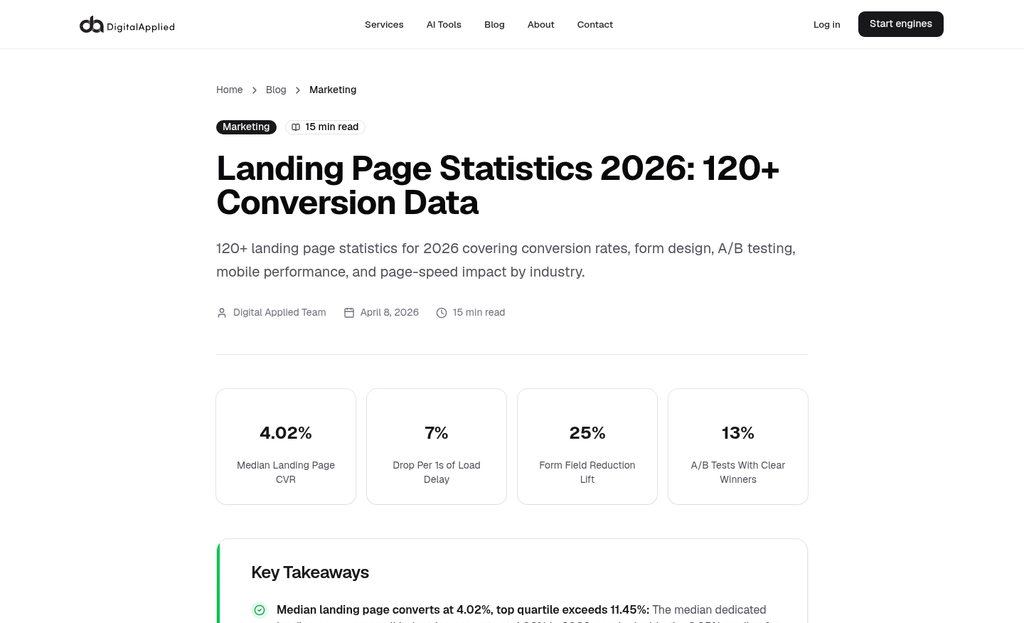
Feature-first framing is another trap that's easy to fall into. Leading with what your product is instead of what it does for you puts the work on the reader to connect the dots. One study found that benefit-led headlines outperform feature-led ones by around 27%, a real gap given how much traffic a landing page might receive.
Jargon is a related problem. A headline written for people already inside your industry - words that only make sense if you already know the product - puts up a wall for everyone else. The most likely to convert are not necessarily the most technically fluent, and writing for insiders shrinks your audience.
Then there's the urge to be clever. A witty or cryptic headline can work in brand advertising; repetition gives it time to land. On a landing page, you have one shot. If someone has to think too hard to know what you do, they'll leave instead of figure it out. Reducing cognitive load on your landing page is one of the more underrated ways to keep people from bouncing at exactly this stage.
So why do so many marketers still default to these patterns? Part of it's pressure - headlines written by committee tend to get sanded down to whatever no one objects to, which is usually something generic. Part of it's that vague headlines feel harder to criticize internally because they don't commit to anything. That internal feedback loop quietly rewards safe over helpful. If you want real data on what's working, understanding why A/B tests so often produce inconclusive results is worth your time before you start testing headline variants.
The result is a headline that passes the internal review and fails with the audience.
The Anatomy of a Headline That Actually Converts
A headline that converts isn't one great line - it's a few things working together at once. Get any one of the things wrong and the whole thing starts to fall apart.
The foundation is a core promise - the single thing your reader walks away believing if they read nothing else on the page. It needs to be grounded in something specific to your product, not a vague claim that could apply to anyone in your space.
Layered onto that is the reader's desired outcome - what they actually want to achieve, not what your product does to help them achieve it. There's a difference there. A project management tool doesn't just "simplify workflows." It helps a team finish a product launch without anyone dropping the ball at the last minute. The second version puts the reader in the picture.

Specificity is what separates a headline that feels believable from one that feels like marketing. Numbers, timeframes, and concrete facts do the heavy lifting here. "Faster results" means almost nothing. "Results in 14 days" gives the reader something to hold onto.
The last piece is language - and it is underrated. Research from conversion copywriting studies has found that headlines written in the reader's own vocabulary can lift conversion rates by around 19%; it's not a small number. People respond to words that feel familiar, not words that feel like they came from a product brochure.
The best place to find that vocabulary is in message-match research and customer interview transcripts. Look at how customers describe the problem before they found your product. What words do they use? What do they say they were scared of, or tired of, or hoping for? Those phrases are more helpful than anything a brand brainstorming session will produce.
Each ingredient earns its place in a headline by doing a job. The promise makes a claim. The outcome makes it personal. The specificity makes it credible. The language makes it feel like it was written for that exact reader. When all four are present, the headline doesn't just describe the product - it reflects the reader back to themselves.
Benefit-Led vs. Feature-Led Headlines - And When the Rules Shift
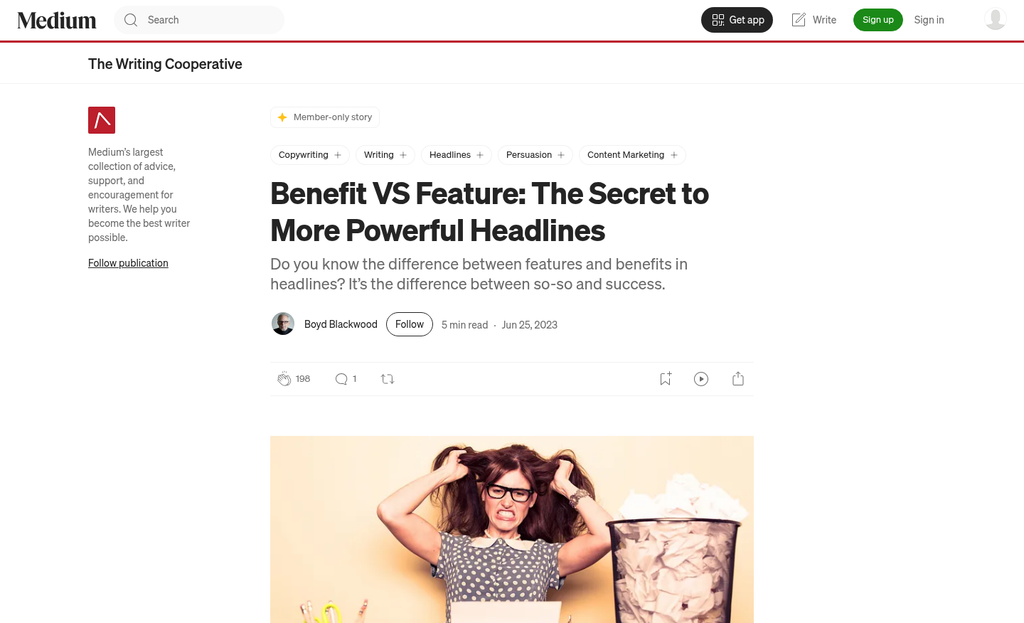
The data makes a strong case for benefit-led headlines. Studies in conversion copywriting show benefit-led headlines outperform feature-led ones by around 27% for general consumer audiences. But feature-focused headlines lag behind by roughly 15% on the same metrics. That gap is hard to dismiss.
A lot of writers go wrong by treating "lead with benefits" as a universal law instead of a starting point.
The logic behind benefit-led headlines is sound. Most don't buy a product for what it is; they buy it for what it does for them. "Never Delete a Photo Again" lands harder than "256GB Storage Included" because it translates the spec into something the reader actually feels. For a general consumer who isn't comparing technical facts, that emotional translation does the heavy lifting. The same principle applies when thinking about the psychology behind high-converting calls to action - framing that connects to feeling tends to outperform framing that simply describes.
Technical audiences are a different story. A developer looking at an API doesn't need you to paint a picture - they need the numbers. "REST API With 99.9% Uptime" tells them what they want to know and it doesn't make them break down a metaphor. In that context, a benefit-led headline can seem vague or condescending.
B2B buyers sit somewhere in the middle, and the answer can depend on where that buyer is in their choice process. Someone who already knows they need SOC 2 compliance will respond to "SOC 2 Type II Certified" immediately. Someone still scoping out the problem space might connect more with "Your Data Stays Compliant." This is especially relevant on high-stakes pages - for instance, webinar registration pages often fail because they pitch features to visitors who haven't yet bought into the benefit.
| Audience Type | Feature-Led Example | Benefit-Led Example | Which Tends to Win |
|---|---|---|---|
| General consumer | 256GB Storage Included | Never Delete a Photo Again | Benefit-led |
| Technical/developer | REST API With 99.9% Uptime | Build Without Worrying About Downtime | Often feature-led |
| B2B buyer | SOC 2 Type II Certified | Your Data Stays Compliant | Depends on buyer stage |
The table above isn't meant to give you a formula to follow automatically - it's meant to prompt thinking about who is actually reading your headline and what they already know coming in. A comparison shopper who has already read three competitor pages is in a different headspace than a person who just found you through a social ad.
The skill is to read the room, then write the line.
How to Test Headlines Without Wasting Weeks of Traffic
A headline that feels great to write can still fail with visitors. The only way to know what actually works is to test it, and the good news is you don't need a massive audience or an expensive setup to get helpful data fast.
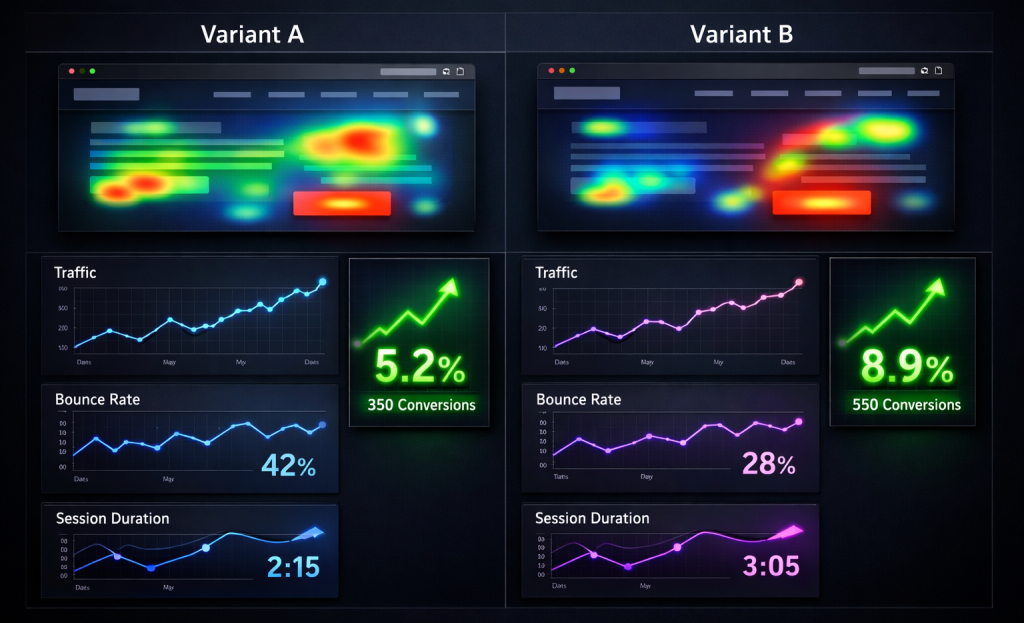
A/B testing is the obvious starting point. You run two versions of your headline at the same time and let traffic choose the winner. Where people go wrong is changing the headline and the subheading and the button text all at once. If one version wins, you won't know which change made the difference. Test one thing at a time, even if it feels slow.
If you don't have enough traffic to reach statistical significance in a reasonable time, five-second tests are a helpful shortcut. Tools like UsabilityHub let you show your landing page for five seconds and then ask what visitors remember. If your headline isn't what they remember, it isn't doing its job. This test takes an afternoon to set up and gives you directional feedback within a day or two.
You can also go more direct than that. Put two or three headline options in a poll and send it to a small group of people who match your target customer. Ask them which one makes them want to learn more. It's not a perfect science, but it cuts through guessing faster when you're stuck between options. If you want a more structured approach, split testing your topic ideas before creating content follows a similar principle.
Heatmap tools like Hotjar let you see where visitors look and how far they scroll. If visitors are dropping off before they can even reach your call to action, your headline might not be building enough momentum to pull them down the page. What your scroll depth data reveals is a different signal than a low conversion rate, and it points you toward a different fix.
The numbers behind headline testing are worth taking seriously. A single headline change on a landing page has been documented to produce conversion lifts above 100%. It's not a rare edge case - it's a reminder that the first line of copy carries more weight than almost anything else on the page. Tools built specifically for this kind of work, like A/B testing tools designed for smaller sites, make it easier to run clean tests without overcomplicating your setup.
Start with one test, measure it properly, and then move to the next. That's the whole system.
Your Next Headline Is One Rewrite Away
Writing a stronger headline doesn't require creative genius - it requires honesty - about who your reader is, what they already want, and if your latest headline speaks to that or just describes what you sell. Those are two very different things, and most landing pages are stuck on the wrong side of that line.

The only next step that matters: open your landing page and read your headline as if you're seeing it for the first time. Ask yourself if a stranger - tired, skeptical, and halfway out the door - would feel like it was written for them. If you pause even slightly, you have your answer. Rewrite it. Test it. Then rewrite it again; it's not a failure of the process; it's the process working as it should.
FAQs
Why do most landing page headlines fail to convert?
Most headlines fail because they prioritize vague, clever-sounding copy over clearly communicating what the product does for the reader. Phrases like "Empowering teams to do more" sound professional but don't answer the visitor's core question: what does this do for me?
What are the key elements of a converting headline?
An effective headline combines a core promise, the reader's desired outcome, specificity, and language borrowed from customer vocabulary. When all four elements work together, the headline reflects the reader back to themselves rather than simply describing the product.
Should landing page headlines lead with benefits or features?
Benefit-led headlines outperform feature-led ones by around 27% for general consumers, but technical audiences often respond better to features. B2B buyers fall somewhere in between, depending on where they are in their decision-making process.
How can I test headlines without large amounts of traffic?
Five-second tests using tools like UsabilityHub provide fast directional feedback without requiring large traffic volumes. You can also poll a small group of target customers or use heatmap tools to see where visitors drop off.
How much impact can a single headline change have?
A single headline change has been documented to produce conversion lifts above 100%, making it the highest-leverage copy element on any landing page. This makes headline testing one of the most valuable optimization activities available.

